
A high school track meet is a set of running, jumping and throwing events run in a published order, and athletes score points for their team by placing. Big sprint fields run heats with the fastest advancing to a final, while longer races are often run once, as timed sections.
The season is in the spring, most athletes can enter up to four events, and the best in each state advance through league, district or regional meets to a state championship. If you're new to high school track as a parent, two things will trip you up: timed sections (your kid can win a heat and place fourth) and team scoring. Both get their own section below.
High school track, the short version
Outdoor track is a spring sport, and some states also run a winter indoor season. The NFHS rule book is the national base, and each state association adds its own rules on top. The events fall into six groups: sprints, distance, hurdles, relays, jumps and throws.
You'll see three kinds of meets. A dual meet is two teams. Small meets have three or four. Invitationals bring in many more. Scoring is points for places: a dual meet scores 5-3-1, and larger meets score 6 to 8 places. Under NFHS rules an athlete can do four events by default, relays included, though states may allow up to six. Qualifying for state happens through a series of postseason meets, and every state sets its own system.
What events are in high school track and field?
The exact list varies by state, but this is the core program. Race distances are in meters.
If your athlete runs the 400 or the 1600, our guides to the 400m and the mile and the 1600m explain those races in depth.
How does a track meet work?
Every meet runs from a time schedule or a rolling order of events. Running events go one after another on the track. Field events happen at the same time around the infield, often in groups called flights.
Here's a typical order of finals, from one state association's official order of events (Kansas): the 100m and 110m hurdles, then the 100m, 1600m, 4x100 relay, 400m, 300m hurdles, 800m, 200m, 3200m and finally the 4x400 relay. In that order, girls race first, then boys, in each event. The 4x800 and any preliminary rounds come before the finals. Your meet may be different, so the time schedule is your best guide.
Before each race, athletes check in with the clerk of the course, who assigns heats and lanes. Field event athletes report to the judge at their event.
What is the difference between heats and finals?
When too many athletes enter a sprint or hurdle race, they run preliminaries first. The top finishers in each heat advance, and the next fastest times fill the final. In Kansas, for example, sprinters and hurdlers qualify by place first, then by time.
Longer races are often a timed final instead. The race is run once, in several sections, and places are decided by time across all of them. Kansas regionals do this for the 400, the 300m hurdles and everything longer. The fastest athletes usually run in the last section.
Field events work their own way. Athletes get a set number of attempts, and the best marks advance to a final for more. In Kansas regional meets, for example, finalists get three more trials.
So if your athlete wins their section of the 800 and ends up fourth overall, nothing went wrong. In a timed final, the clock decides.
How is a high school track meet scored?
Athletes score points for their team by placing. The NFHS rule book sets a default table based on how many teams are in the meet, unless the meet announces its own system.
In a dual meet, first place is worth 5, second 3 and third 1, and in a relay only the winner scores. A sweep of the top three in an event is worth 9 points to 0. At an invitational, points go deeper, so a sixth or eighth place can still help the team.
Ties split the points. Two athletes tied for third in a 10-8-6-4-2-1 meet share the points for third and fourth. Championship meets set their own rules: Kansas regionals, for example, score seven places, 10-8-6-4-3-2-1, relays included.
How long is a high school track meet?
It depends on how many teams, events and heats there are. A small dual meet moves a lot faster than an invitational with dozens of heats and field event flights. Check the time schedule, find your athlete's events and plan to stay for the whole block, because rolling schedules run early or late.
Weather can add time. Under the NFHS lightning guideline, activity stops for at least 30 minutes after the last thunder or lightning, and any new strike restarts the clock.
How many events can a high school athlete do?
Under NFHS Rule 4-2-1, an athlete can compete in four events at a meet, and a relay counts as one of them. Since 2024, a note in the rule lets state associations set their own limit, up to six. Ohio, for example, keeps it at four, in the regular season and the postseason. Ask the coach which rule your state uses.
How does qualifying for state work?
Every state runs its own postseason, so treat this as the general shape and then read your state association's manual.
- Regular season: athletes build marks and earn their spot in the postseason lineup. Some states limit how many entries each school gets per event.
- League, district or sectional meets: the first round of the postseason in most states.
- Regional meets: the top finishers advance.
- State meet: often split by school size or classification.
Advancement usually comes from place, sometimes with extra spots for the best marks. In Kansas, the top three in each regional event qualify for state, and the next six best performances across regionals also qualify. Some states use qualifying standards instead of place, or on top of it.
How can you support your athlete at meets?
- Learn their events and the schedule. Know when to be at the rail and when to go get food.
- Stand where they can hear you. The last 100 meters and the exchange zones are good spots for runners. Field event athletes hear you best from behind the runway.
- Let the coach coach. Save the race analysis for later. After a race, a hug and food go further than splits.
- Celebrate personal bests. In track, the clock and the tape measure show progress even when places don't.
- Pack for a long day: a seat, layers, sunscreen and water. Athletes can use our track meet checklist.
What should athletes wear and bring?
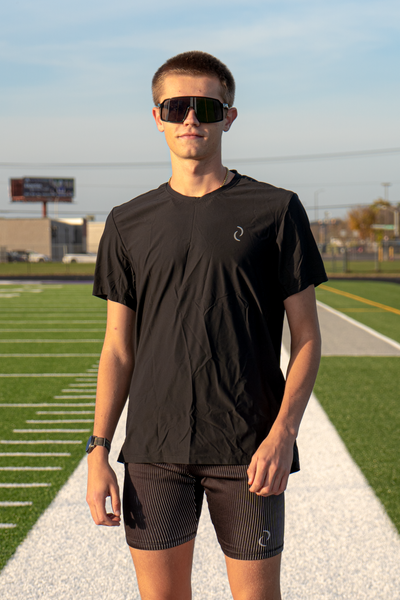
Race in the school uniform and gear you've trained in. For practice and warm-ups, our running split shorts come in a 2.5 inch inseam (RD Split Shorts) and a 4 inch inseam (LD Split Shorts), and any 2 shorts get the 3rd free. Our running half tights have an inseam of about 9 inches, with two inner gel pockets and a back zip pocket that fits a phone.
For the season's big moment, our track and field posters celebrate the events, and you can buy 2 and get 1 free. Shopping for your athlete? See our gifts for track and field athletes.
High school track FAQ
How does scoring work in high school track?
Athletes score points by placing. Under the NFHS default table, a dual meet scores 5-3-1 in individual events and 5 for the relay winner. Meets with six or more teams score 10-8-6-4-2-1, and larger meets can score seven or eight places.
What is the difference between a dual meet and an invitational?
A dual meet has two teams and scores only the top three places. An invitational hosts many teams and scores deeper, usually six to eight places.
How many events can you run in high school track?
Four by default under NFHS Rule 4-2-1, relays included. Since 2024, states may set their own limit, up to six.
What does "final on time" mean?
The race is run once in sections, and places are decided by time across all sections, not by who wins each section.
How do you qualify for the state track meet?
Through your state's postseason: usually league or district meets, then regionals, then state. Places, and in some states qualifying marks, decide who advances. Check your state association's manual.
Why do some races have heats?
When more athletes enter than there are lanes, sprints and hurdles run preliminary heats. The top finishers and next fastest times advance to the final.
How long does a track meet take?
It varies with the number of teams and events. Invitationals can run for many hours, so use the time schedule to plan around your athlete's events.