
Plenty of cross country races go wrong before the gun, and not because of fitness. Pins too short for a course that turned to mud overnight. A spike wrench left on the kitchen counter. A long sleeve you start to hate at the first mile and can't legally take off. Pack the night before with the checklist below, and make every clothing decision before you walk to the start line.
Championship meets in late October make all of it matter more. The courses are often churned up, the mornings are cold, and one small mistake now costs places that count.
What spikes and pins should you bring?
Spikes, a spike wrench and spare pins in two lengths. Then pick which pins go in after you walk or jog the course, not the night before at home.
The limit is simple. In high school, cross country spikes can be no longer than 1 inch. In college the NCAA limit is 25 mm. Inside that limit, longer pins grip on soft grass and mud, and shorter ones are better on firm, dry ground. If part of the course is paved or packed hard, go shorter, because long pins on a hard path feel like running on nails.
Check every pin at home. A rusted pin that won't come out at the course means you race on whatever is already in the shoe. Keep the wrench and the spares together in a small zip bag so they aren't loose at the bottom of your backpack. Still deciding between spikes and flats? Cross country explained covers it.
Can you take off a layer during the race?
No, and this is the rule that catches people. Under the NFHS uniform rule high schools use, removing any part of your uniform except your shoes in the competition area is illegal. The first time gets a warning. Do it again and you're disqualified.
Two more parts of that rule matter on a cold day. Any outer layer you race in, like a long sleeve or tights, has to be school issued or approved, and once you start in it, it is your uniform. And teammates have to look like one team through color, logo and outer garments. So if you want a long sleeve for the championship, ask your coach how the team is handling it that week. Not on the line.
The practical version: you get one decision, made before the gun. If you're unsure, go lighter. You'll be warm by the first mile, and overdressing can't be fixed once you're running.
Why pack a full set of dry clothes?
Because you will finish wet. Sweat, rain, mud, usually some of each. Standing around in a soaked uniform while the team waits for results is how a good day ends with you shivering on the bus.
Dry means all of it: socks, underwear, shirt, pants and a warm top. Add a towel and a plastic bag for the muddy spikes and the wet uniform so the rest of the bag stays clean.
The checklist
Print it and check things off as the bag fills up.
- Uniform top and bottom (school issued or approved)
- Spikes, pins checked
- Spike wrench and spare pins in two lengths, in a zip bag
- Trainers for the warm up and cool down
- Racing socks plus two spare pairs
- Four safety pins for your bib, plus spares for teammates
- Warm up jacket and pants
- Hat and gloves
- Rain jacket
- Full set of dry clothes and a warm top
- Towel
- Plastic bag for muddy spikes and the wet uniform
- Slides or a second pair of shoes
- Water bottle
- Snacks you've eaten before races, and real food for after
- Sunscreen, lip balm, athletic tape, hair ties
- The course map, saved on your phone
What should you wear on a cold championship day?
Race in the uniform. Most of this table is about the time before the gun and after the finish, which on a big meet day is most of the day.
Anything visible under the uniform counts as a foundation garment under the NFHS rule, with no limits on logo or color. The outer layer is the one that needs your coach's yes.
How should race day run?
- The night before: pack from the list, lay out the uniform, check the forecast and the course map.
- Arrive early. Find the team area, drop your bag and get your bib.
- Walk or jog the course if the meet allows it. Look at the start, the first turn, the muddy sections and the last 400 meters. Pick your pins.
- Warm up in trainers, the same way you do before every race.
- Spikes on, bib pinned flat at all four corners, layers off and handed to a teammate or left in the team area.
- Get to your team's box on time and know where the first turn is.
- After the finish: keep walking, drink something, get into dry clothes, then cool down in trainers.
Once you're in the box, the plan for the race itself is in how to run a cross country race. If championship week has you second guessing your training, how to peak for cross country championships covers the taper.
Should you bring your own water?
Yes, every time. Under NFHS guidance, host schools can put water at the finish, and the games committee can allow water stations on the course when the weather calls for it. Some state associations and meets go the other way and ask every team to bring its own, with at least 48 hours' notice. That notice goes to your coach, not you. A bottle in your bag covers both cases.
What happens if there's lightning?
The meet stops. Under the NFHS lightning guideline, activity is suspended and can restart only 30 minutes after the last thunder or lightning, and any new thunder or lightning starts the count over. A couple of storms can turn that into a long wait. That's when the extra layer, the snacks and the dry clothes earn their spot in the bag.
What should parents bring?
Shoes you can walk in, since courses are spread out and you'll want to see your runner at more than one spot. Layers, a rain jacket, water, a chair or blanket, and the course map so you can plan where to stand. Spare safety pins in your pocket will make you popular with the whole team. And if this is your senior's last championship, our gifts for cross country runners guide has ideas beyond another team shirt.
Shorts for the miles around the race
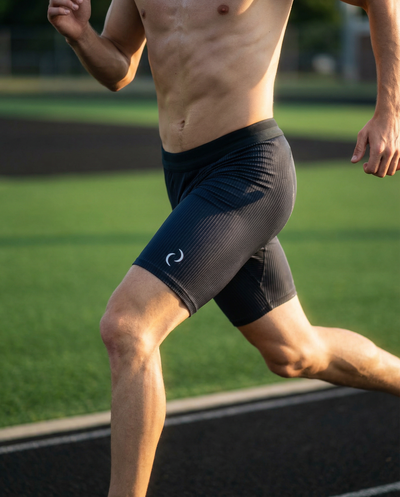
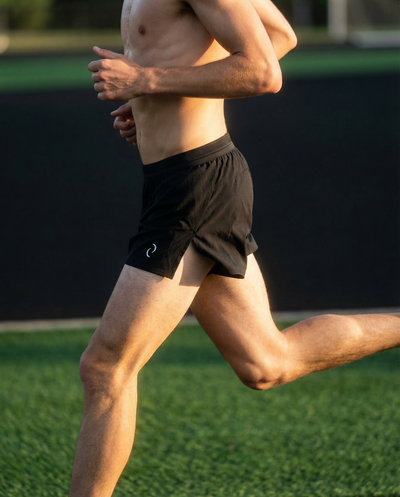
On race day you run in what your team issues. The warm up, the shakeout the day before and the easy miles between meets are what our running split shorts are for. They come in a 2.5 inch and a 4 inch inseam, and any 2 shorts get the 3rd free.