
800m workouts have to train two engines at once. Roughly 60 to 75 percent of the energy for an 800 comes from the aerobic system and the rest from the anaerobic system, so good 800m training mixes easy mileage and threshold runs with fast, painful repeats at or faster than race pace.
Skip either side and the race finds you out, usually somewhere on the second lap. This is a guide to how 800 training is built, not a plan. Work with your coach, and build up gradually.
What makes 800m training different?
The 800 sits between the sprints and the distance events. A 2021 review of world class 800m and 1500m training put the 800 at about 60 to 75 percent aerobic and 25 to 40 percent anaerobic. An earlier study of trained runners measured about 66 percent aerobic for the 800, against 43 percent for the 400 and 84 percent for the 1500.
That split explains the event. A pure sprinter runs out of aerobic support on the second lap. A pure distance runner doesn't have the speed to be in the race at 400. So 800 training covers more of the pace spectrum than almost any other event, from easy runs to near maximal sprints.
The same review found that lactate sessions are used particularly by 800m specialists, and that they run less total volume than 1500m runners: about 50 to 120 km a week (roughly 30 to 75 miles) at world class level in the heavy part of the season, against 120 to 170 km for 1500m runners. Younger and newer runners do far less than that.
What are the main types of 800m workouts?
Easy running
Most running in any 800 program is easy. It builds the aerobic base that carries you through the second lap and lets you recover between hard days. You should be able to talk the whole time.
Threshold runs
Threshold work builds aerobic power and pace control. It's steady running at a pace usually described as "comfortably hard": faster than easy, well below race effort. You can do it as one continuous run or as longer repeats with short rests (often called cruise intervals).
VO2max intervals
These raise the ceiling of your aerobic system. They're repeats of about 2 to 4 minutes at roughly 3K to 10K race pace with 2 to 3 minutes of recovery. Typical sessions in the 2021 review: 4 to 7 x 800 to 1000m, or 2 sets of 6 x 400m.
Lactate tolerance
This is the "hold on" training 800 runners are known for, and it teaches you to hold pace while fatigue builds. Many short repeats at around 800m to 1500m race pace, short rests, and the fatigue stacks up through the session. The review's typical example is 10 to 16 x 200m with 1 minute of recovery. If you're newer, start at the low end of the rep count.
Lactate production (speed endurance)
Fewer, faster repeats with full recovery, run at roughly 200m to 600m race pace, so you learn to run fast under fatigue. The typical example is 5 to 7 x 300m with 3 to 5 minutes of recovery. The goal is quality. When the times fall apart, the session is over.
Race pace
Race pace sessions build rhythm and pace judgment. They teach you what goal pace feels like, so you don't go out too hard on the first lap, and they double as fitness checks. A standard one is 4 x 400m at goal pace with 3 minutes of rest.
Speed
Short sprints of about 5 to 15 seconds at near maximal effort, with full recovery, keep your top speed high and your stride efficient. Hill sprints (short, steep and fast) are a common way to do it. The higher your top speed, the less 800 pace costs you.
Sample 800m workouts
These sessions are common in published coaching practice. They're examples, not a prescription. Warm up well before every one, and cool down after.
- 4 x 400m at 800m goal pace, 3 minutes rest. A classic race pace session. Doubling your average 400 gives a rough read on current 800 fitness.
- 5 x 300m, 90 seconds rest. Run at about 800m pace. A 45 second 300 is 2:00 pace.
- Broken 800: 2 sets of 2 x 400m. 1 minute between the 400s, 10 minutes or more between sets. Average the two broken 800s to see where your race pace sits.
- 8 x 200m at 800m pace, 200m jog recovery. Rhythm at goal pace with enough recovery to hold form.
- Ladder: 600, 400, 300, 200, 500 at 800m goal pace. About 3 minutes or a 400m jog between each. The 500 at the end teaches you to hold pace when you're tired.
- 5 to 7 x 300m fast, 3 to 5 minutes rest. Lactate production. Faster than 800 pace, full recovery, stop when the times fade.
- 10 to 16 x 200m, 1 minute rest. Lactate tolerance at about 800m to 1500m pace. Start with fewer reps.
- Hill sprints of about 8 to 12 seconds. Maximal effort up a steep hill, walk down and rest fully. Short and sharp, not a hill workout for fitness.
800m goal pace table
Every split below is even pace. Use it to set targets for race pace sessions.
How many hard workouts a week for the 800?
The 2021 review found that world class middle distance runners do 2 to 4 intensive sessions a week while building, and 800m specialists run 3 to 4 in the competition phase. Races count as hard days. Most high school and college runners do fewer. A common pattern in coaching practice is 2 hard sessions a week plus a race, with easy days in between.
One rule holds at every level: follow a hard day with an easy one. Fitness gets built in the recovery, not only in the workout.
How do you taper for an 800?
The same review suggests about 1 week is enough for middle distance runners, cutting training volume by about 40 to 60 percent while keeping some short work at race pace. Keep the intensity, drop the volume and show up rested.
Are Yasso 800s good for 800m training?
No. Yasso 800s are a marathon workout: 10 x 800m, where your average rep time in minutes and seconds is used as a rough predictor of marathon time in hours and minutes. They share a name with the 800m and have nothing to do with racing it.
Common 800m training mistakes
- Only running fast. About two thirds of the 800 is aerobic. Skip the easy miles and threshold work and it shows up on the second lap.
- Only running long. Distance runners who never run faster than 800 pace struggle when the pace goes out at 400 speed.
- Racing every workout. Lactate sessions hurt enough on their own. Hit the target times. Don't beat them by 3 seconds a rep.
- Stacking hard days. Two hard days in a row usually means the second one is slow and the next race is flat.
- Ramping up too fast. Build volume and intensity gradually. There's no magic percentage: a 2008 study of novice runners found the popular "10 percent rule" did not lower injury rates, so progress by feel and with your coach.
What to wear for 800m workouts
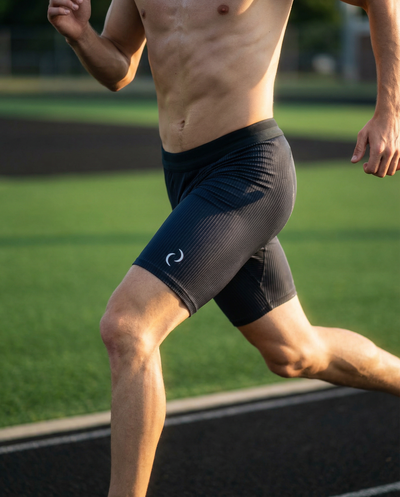
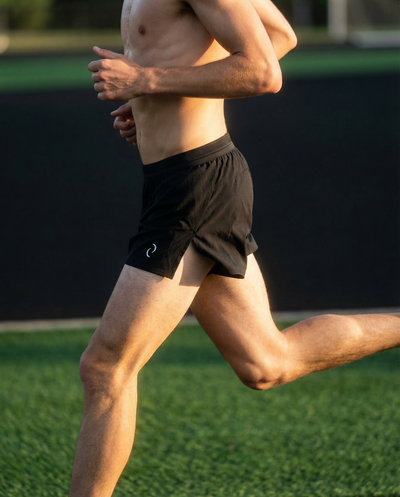
Track sessions need gear that moves at full stride. Our running split shorts come in a 2.5 inch inseam (RD Split Shorts) and a 4 inch inseam (LD Split Shorts), and any 2 shorts get the 3rd free. For cold early season sessions, or if you like compression, our running half tights have an inseam of about 9 inches, two inner gel pockets and a back zip pocket that fits a phone.
If someone you know lives at the track, our track and field posters are for their wall. For what the 800 is, the records and why people call it the hardest race on the track, read the 800m, the hardest event in track and field.
800m workouts FAQ
What is a good 800m workout?
One that matches the goal of that week. 4 x 400m at goal pace with 3 minutes rest is a classic race pace workout. 5 to 7 x 300m fast with full recovery builds speed endurance. Both are common in coaching practice.
How do 800m runners train?
They mix easy running and threshold work for the aerobic side with short, fast repeats for the anaerobic side, plus race pace sessions and short sprints. The 800 is about 60 to 75 percent aerobic, so both matter.
How many miles a week should an 800m runner run?
It depends on age, experience and your coach's plan. For context only, a 2021 review found world class 800m runners covered about 50 to 120 km (about 30 to 75 miles) a week in the heavy part of their season. Developing runners do much less.
What pace should 400m repeats be for the 800?
For race pace work, half your goal 800 time. A 2:00 goal means 60 second 400s. A 2:20 goal means 70 second 400s.
How long before a race should you taper for the 800?
About 1 week is enough for most middle distance runners, according to a 2021 review of world class training. Cut volume and keep some short race pace work.
Are Yasso 800s for 800m runners?
No. Yasso 800s are a marathon predictor workout. They aren't designed for racing the 800m.